


By W. Barry Nixon, COO, PreemploymentDirectory.com
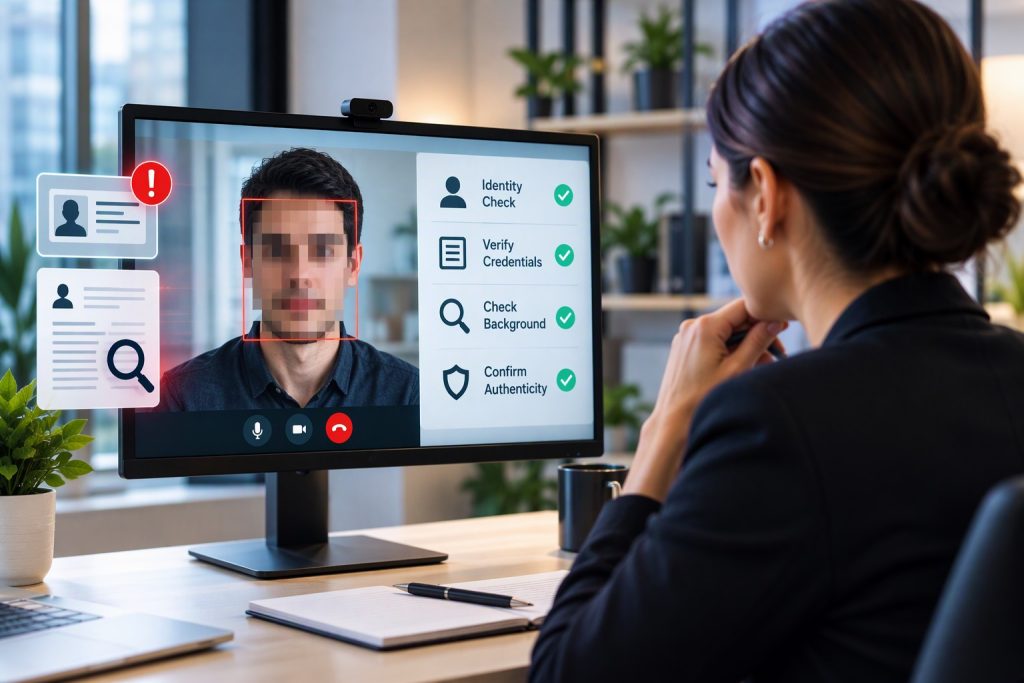
Advances in artificial intelligence and remote hiring have created new opportunities for employers, but they have also introduced new forms of hiring fraud. A candidate appearing on camera during a virtual interview was once considered sufficient proof of identity. Today, deepfake technology and professional proxy interviewers have made that assumption increasingly unreliable.
Research suggests that candidate fraud is growing, and organizations that fail to strengthen their hiring controls face risks that extend far beyond a poor hiring decision. Fraudulent workers may gain access to corporate systems, sensitive intellectual property, customer information, and, in some cases, could expose organizations to sanctions and regulatory concerns.
The challenge is not limited to one stage of recruitment. Hiring fraud often succeeds because organizations view hiring as a series of separate activities rather than a connected process. To reduce risk, employers must build verification measures into every phase of the candidate journey.
Understanding Modern Candidate Fraud
Most hiring managers associate candidate dishonesty with embellished resumes or the use of AI-generated interview responses. However, identity fraud is far more serious.
In these cases, the individual who applies for the position is not necessarily the person who ultimately performs the work. Employers may unknowingly provide network access, equipment, confidential information, and compensation to someone whose identity was never properly verified.
The most common forms of hiring identity fraud include:
Proxy Interviews
A candidate hires another individual to participate in interviews on their behalf. The proxy successfully answers technical or job-related questions, helping secure the position. Once hired, a different person begins performing the work.
Deepfake Technology
Deepfake software can replace or alter a candidate’s appearance during a live video call. Modern applications can operate within common meeting platforms such as Zoom, Microsoft Teams, and Google Meet, making visual verification significantly more difficult.
Why Remote Technology Roles Are Frequently Targeted
Fully remote positions, particularly in information technology, are especially attractive to fraudsters. Because candidates rarely meet employers face-to-face, they can potentially move through the entire hiring process without their true identity being discovered.
Technology positions are particularly vulnerable because qualified talent is in high demand. Hiring managers often move quickly when they identify candidates possessing specialized skills. This urgency can reduce scrutiny and increase the likelihood that fraudulent candidates progress through the recruitment process.
Recent law enforcement investigations have highlighted schemes involving foreign actors obtaining remote positions using stolen identities and falsified credentials. In many cases, these individuals are technically capable workers, allowing them to remain employed for extended periods without drawing suspicion.
Building Fraud Detection Into Every Hiring Stage
The most effective approach is to view hiring as a continuous verification process rather than a series of isolated events.
Candidate Sourcing and Screening
Organizations should focus verification efforts on shortlisted candidates. Practical steps include:
- Performing reverse image searches on profile photographs.
- Verifying that references are legitimate individuals.
- Confirming that previous employers are real organizations.
- Reviewing unusual resume language that may have been copied or fabricated.
- Comparing references across applicants to identify suspicious patterns.
Conducting Secure Video Interviews
Video interviews remain valuable, but employers should introduce additional safeguards.
Consider requiring:
- Government-issued identification verification.
- Cameras to remain on throughout interviews.
- Disabled virtual backgrounds or image-blurring features.
Interviewers can also watch for signs that may indicate identity manipulation:
- Visual distortions when a candidate moves their hands near their face.
- Delays between questions and responses.
- Answers that seem inconsistent with the candidate’s claimed location or background.
- Environmental details that do not align with the candidate’s stated circumstances.
Casual questions about local landmarks, neighborhoods, or favorite restaurants can sometimes reveal discrepancies that warrant further review.
Strengthening Hiring Handoffs
Hiring fraud often exploits transitions between recruiters, talent acquisition teams, hiring managers, HR professionals, and direct supervisors.
A simple solution is to conduct brief joint introductions during candidate transitions. This allows multiple stakeholders to interact with the same individual and increases the likelihood that inconsistencies will be detected.
Reviewing Equipment and Shipping Requests
For remote employees, equipment delivery can provide another important verification opportunity.
Unexpected requests to change shipping addresses during the hiring process should receive additional scrutiny. Organizations should compare equipment delivery addresses with information provided on applications, resumes, and employment documentation.
While address changes are not automatically suspicious, they may signal attempts to route equipment through third parties.
Recognizing Patterns Instead of Single Red Flags
No single indicator proves a candidate is fraudulent. Instead, organizations should focus on identifying patterns.
A suspicious address change alone may be harmless. An unusual address change combined with a questionable interview, inconsistent references, and identity verification concerns may point to a more significant issue.
Employers should establish clear escalation procedures so recruiters know exactly where to report concerns and who is responsible for investigating them.
When a Fraudulent Candidate Is Discovered
If an organization learns that a fraudulent individual has been hired, immediate action is essential.
Recommended steps include:
- Consult legal counsel to assess regulatory, sanctions, and compliance implications.
- Conduct a security review to determine whether systems, intellectual property, or sensitive data have been accessed.
- Notify appropriate law enforcement authorities when circumstances warrant.
- Document findings and responses to support any future investigations or regulatory inquiries.
Acting quickly can help limit both legal exposure and cybersecurity risks.
Evaluating Staffing Partners
Organizations that rely on staffing agencies should ensure fraud prevention is part of the agency’s recruitment process.
Key questions to ask include:
- What verification procedures are used for remote candidates?
- How are references validated?
- How are recruiter-to-manager handoffs handled?
- What training do recruiters receive on detecting fraud indicators?
- What technologies are used to identify suspicious candidate behavior?
A strong staffing partner should be able to clearly explain how candidate authenticity is verified throughout the hiring lifecycle.
Final Thoughts
The rise of deepfakes, proxy interviews, and sophisticated identity schemes has fundamentally changed the recruiting landscape. Traditional hiring practices alone are no longer enough to verify candidate identity, particularly for remote roles.
Employers that implement layered verification controls across sourcing, interviewing, onboarding, and equipment management can significantly reduce their exposure to hiring fraud. The goal is not to create barriers for legitimate candidates, but to establish a hiring process that verifies trust before granting access to company resources, data, and payroll.