


Key Insights from CISA’s New Insider Threat Guidance for Employers, Background Screening and Workforce Risk |
back to blog
Kevin Prendergast, President at Thuro
November 21, 2026
Companies spend millions protecting their networks from outsiders. They invest in firewalls, intrusion detection, multifactor authentication and sophisticated cybersecurity defenses designed to prevent unauthorized access.
But what happens when the person who poses the greatest risk already has a company-issued credential, an approved login and legitimate access to sensitive information?
That individual may be an employee, contractor or trusted vendor. No firewall can independently determine whether someone who has been granted access is trustworthy, whether their circumstances have changed or whether their identity was genuine in the first place. The most consequential security breach may not begin with someone breaking through an organization’s defenses. It may begin with someone who was invited inside.
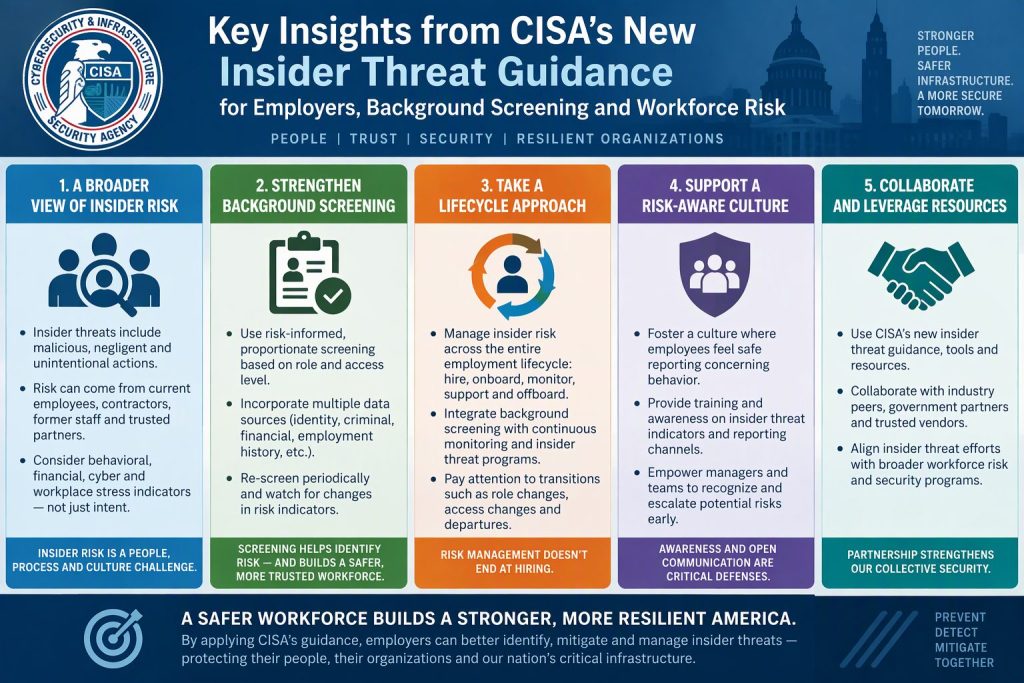
In September 2026, the Cybersecurity and Infrastructure Security Agency (CISA) published its 113-page Insider Threat Mitigation Guide, a comprehensive framework for identifying, assessing and managing risks associated with trusted insiders. The guidance addresses malicious conduct, negligence, compromised insiders and threats involving third parties.
This paper distills the lessons most relevant to business leaders, with particular attention to identity verification, background screening, third-party due diligence and ongoing workforce risk management. The guide offers voluntary best practices, not a new screening mandate.
The Financial Consequences of Insider Risk
CISA opens its analysis with a striking reminder: insider incidents are costly, difficult to contain and frequently underreported. Its Figure 1 draws on external research estimating that the average annualized organizational cost of insider incidents increased from $16.2 million in 2023 to $17.4 million in 2024. The same infographic cites an average 81 days to contain an insider incident. These figures are study-based estimates, not a prediction of what any particular company will lose.
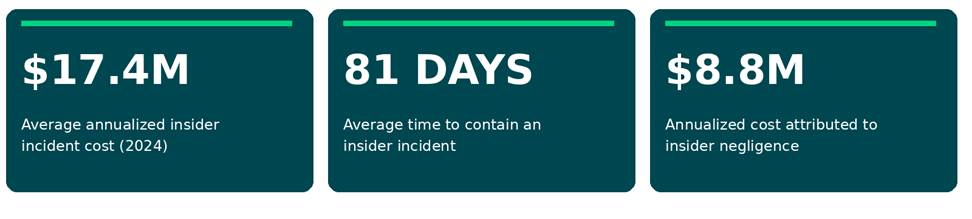
Source: CISA, Insider Threat Mitigation Guide (September 2026), Figure 1, p. 6; underlying figures from cited third-party research.
Not Every Insider Threat Is a Malicious Employee
The term “insider threat” often evokes an employee deliberately stealing confidential information. CISA describes a broader problem. A malicious insider may intentionally misuse access, disclose information or sabotage operations. A negligent insider may expose information through error or poor security practices. A compromised insider may have credentials or access exploited by someone else. Contractors, vendors and other third parties may also create insider exposure when they are trusted with organizational systems or facilities.
Artificial intelligence adds another dimension. Deepfake video and audio, stolen identities and AI-enabled social engineering can make it harder to establish that a person is who they claim to be. These are contemporary risks that amplify the practical importance of verification; they should not be mistaken for a finding that CISA’s guide endorses any particular identity-verification technology.
Before the Credentials: Know Who Is Being Granted Access
One of the guide’s most relevant passages appears in its discussion of “Background Indicators.” CISA explains that background checks can identify historical information not readily observable by supervisors or colleagues before a person is hired or granted access to facilities or networks. It notes that an in-depth check may be appropriate depending on the risk and expressly recommends involving legal counsel to ensure compliance with applicable law (p. 64).
The practical lesson is not that every person should undergo the same exhaustive investigation. It is that screening should reflect the position, the sensitivity of the information involved and the consequences of misuse. Organizations should ask whether they know the real identity of the person receiving access, whether relevant employment and credential claims have been verified and whether contractors and vendors are subject to controls commensurate with their access.
A basic criminal record search alone may not address the full range of risks. Depending on the role and lawful purpose, a thoughtfully designed program may include identity verification, employment and education verification, professional credential checks, relevant public-record research and third-party due diligence. The objective is informed, defensible decision-making—not the promise of predicting future misconduct.
Trust Is Not a One-Time Decision
A background report is a snapshot. The individual screened at onboarding may later receive privileged system access, move into a more sensitive role, assume financial authority or become involved in a new vendor relationship. CISA’s framework extends beyond initial vetting to detection, assessment, intervention and risk management. It emphasizes multidisciplinary coordination and an approach tailored to the organization’s assets and circumstances.

Thuro illustration of a risk-based access lifecycle, informed by CISA’s broader mitigation framework.
A sound program therefore considers what happens after onboarding: periodic reviews where lawful and justified, prompt reassessment following material changes in access or responsibilities, clear procedures for reporting concerning behavior and disciplined termination of credentials when relationships end. Risk signals should be evaluated in context, not treated as proof of wrongdoing.
Security Must Operate Within Legal Boundaries
Insider threat programs involve sensitive information about people. CISA repeatedly acknowledges the need to balance security objectives with privacy, civil liberties and other legal protections. Its discussion of background indicators includes examples that can implicate disability, protected activity and other highly sensitive subjects. An item appearing in a federal guide does not make it a lawful employment screening criterion.
Employers using consumer reports for employment purposes must consider the Fair Credit Reporting Act’s disclosure, authorization and adverse-action requirements, as well as applicable state and local laws. Fair chance restrictions, privacy obligations, disability discrimination protections and rules governing workplace monitoring may further limit what information can be collected or how it can be used. Requirements depend on the jurisdiction, the screening method and the decision being made.
This is why HR, legal, security, IT and procurement should coordinate. Effective mitigation is not a license for indiscriminate surveillance or perpetual background checks. It is a structured effort to identify material risks, select proportionate safeguards, document decisions and protect individual rights.
Five Questions for the Executive Team
- Do we reliably establish the identities of employees, contractors and vendors before granting meaningful access?
- Does screening reflect the sensitivity of the role, the systems involved and applicable legal restrictions?
- Do we reassess controls when a person’s access, responsibilities or risk profile materially changes?
- Do HR, legal, cybersecurity, physical security and procurement share a defined process for escalating concerns?
- Do our offboarding procedures promptly terminate credentials and recover access when relationships end?
The Firewall Is Only One Line of Defense
Organizations cannot eliminate every insider threat. They can, however, reduce avoidable exposure by treating trust as something that must be established, appropriately limited and periodically reconsidered. The question for executives is not whether cybersecurity investment matters. It is whether equal attention is being paid to the people who operate behind those defenses.
How confident are you in the people behind your firewall? Thuro offers a complimentary review of identity verification, background screening and related workforce risk controls. Drawing on more than three decades of legal and investigative experience, we help organizations identify potential gaps and strengthen their programs before vulnerabilities become costly problems. Contact us at thuro.ai to discuss an assessment.