

Why Identifiers Matter: The Case for Resume-Grade Identity Resolution in Social Media Screening |
back to blog
By Jaime (Coy) Frankos — August 10, 2026
A criminal background check is simple, in the best sense of that word. In the U.S., name and date of birth are typically sufficient to match against a court record with real confidence. Internationally, the bar rises — name, DOB, mother’s or father’s maiden name, and a passport photo are common, with each country layering on its own requirements. Either way, the identifiers are defined and the data source is structured.
Social media screening doesn’t work that way. And our industry has been slow to adapt — though that’s changing quickly.
The Problem with Borrowing an Old Standard
When social media screening started gaining traction, a lot of providers — Ferretly included, in our earliest days — leaned on the same bare-minimum identifiers that work for a domestic criminal check: name, age, location. It made sense on paper. It’s what the industry already trusted.
But name, age, and location aren’t enough to confidently attach a handle to a real person. Even international criminal checks know this — the moment you cross a border, providers require more. Social media, a global and unstructured ocean of profiles, is a harder identity problem than any single court system. It deserves at least that same rigor.
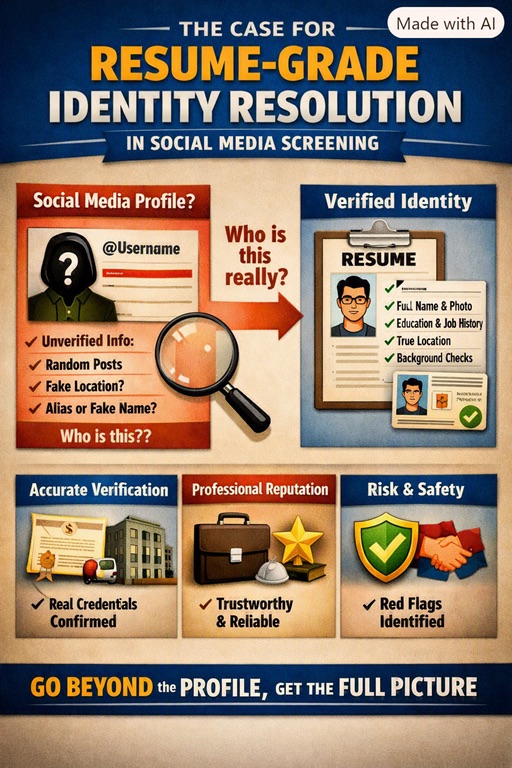
Search “Michael Smith, age 29, Chicago” and you’ll find dozens of accounts that fit. Name, age, and location don’t resolve identity online — they just narrow a haystack that was already too big to search by hand.
What Actually Resolves Identity
Think less like a court clerk, more like a recruiter reading a resume:
- Name — including nicknames and variations
- Location — current and historical
- Employer — current and past, constantly referenced in bios and posts
- Education — school, graduation year, greek life, athletics
- Age or birth year — a starting filter, never a confirming one
- Email or username patterns — often the strongest technical thread across platforms
None of these alone is a smoking gun. Layer three or more together, and you go from “40 people who could be this” to “exactly one person who is this.” That’s why we require a minimum of two to three positive identifiers before we ever attach a handle to a subject. Not a nice-to-have — the difference between a defensible report and a liability.
Get It Through Partnership, Not Paperwork
Most providers treat these identifiers as something to ask for — a separate form, one more thing to chase down. But this data already lives somewhere: a candidate’s application, resume, ATS, or background check intake almost always contains their employer, education, location history, and email.
The right standard isn’t “ask the candidate for more.” It’s build the integration so you already have it. When a provider is genuinely integrated with your ATS or background check platform — like Tazworks or Accio — that resume-grade data flows through automatically. No extra form, no second request, no candidate filling out the same information twice.
When identifiers are pulled through integration instead of requested separately, it removes an entire layer of back-and-forth between provider and client. The report comes back more accurate, faster, with less friction on every side. That’s the difference between a partner who happens to offer social media screening and one who’s actually built it into your workflow.
The Stakes Are Different Than People Think
The cost of a false positive isn’t hypothetical. Attach the wrong person’s posts to a candidate’s report, and you haven’t made an administrative error — you’ve potentially cost an innocent person a job offer over content they never wrote and exposed your client to a discrimination claim they didn’t see coming.
A criminal record mismatch is bad, but it operates within a system built to catch errors. Social media has no such backstop. If identity resolution isn’t rigorous, nothing downstream catches the mistake — the wrong report just becomes the record.
What This Means for Buyers
The most important question to ask any vendor isn’t “what do you screen for.” It’s:
“How many identifiers do you require before attaching a profile to my candidate, and what happens when you can’t hit that threshold?”
A close second: “Do you request those identifiers separately, or pull them through integration with our existing systems?” That answer tells you whether you’re buying a bolted-on product or a true partner.
Speed and cost matter. None of it matters if the report is about the wrong person.
Why This Is Our Standard at Ferretly
I lead partnerships at Ferretly, and identity resolution is something we treat as non-negotiable. I stand behind being a true partner, not a transactional vendor — I want you to succeed in making social media screening a core part of your offering.
Our team doesn’t take a willy-nilly approach to finding handles. We hold ourselves to a standard because we want confidence, every time, that we’ve found the correct handle for the correct person.
Here’s why that matters: the entire premise of social media screening is understanding someone’s character and cultural fit. That only means something if the handle actually belongs to the candidate. A thorough report attached to the wrong person isn’t insight — it’s noise dressed up as insight. Get the identity right, and social media screening delivers exactly what it promises: a clearer view of who someone really is.
Stop Treating the Pilot Like a Test
A lot of companies undercut themselves before they even start. When evaluating a provider, they hold information back — giving the bare minimum, almost like testing whether the provider can succeed despite being under-informed.
That’s understandable instinct, but it works against the very thing you’re trying to evaluate. If identity resolution depends on layered, resume-grade information, withholding that information during a pilot doesn’t test capability — it just guarantees a worse result and tells you nothing real about how the partnership performs live.
So, give a provider everything you’d give them in production. Every identifier, every integration point. Why hold back? Get it out of your head as a test — this isn’t adversarial. Providers and clients should be a team from the first handshake. Let’s talk partnerships — real ones, built on full information and shared incentives.
Let’s Talk About Your Process
If you’re running social media screening today — or considering it — ask your provider how they resolve identity, where that data comes from, and what happens when they can’t hit the threshold. The answers will tell you more than any feature list ever will.
If you’d like to see how we approach this at Ferretly, I’d genuinely welcome the conversation.