

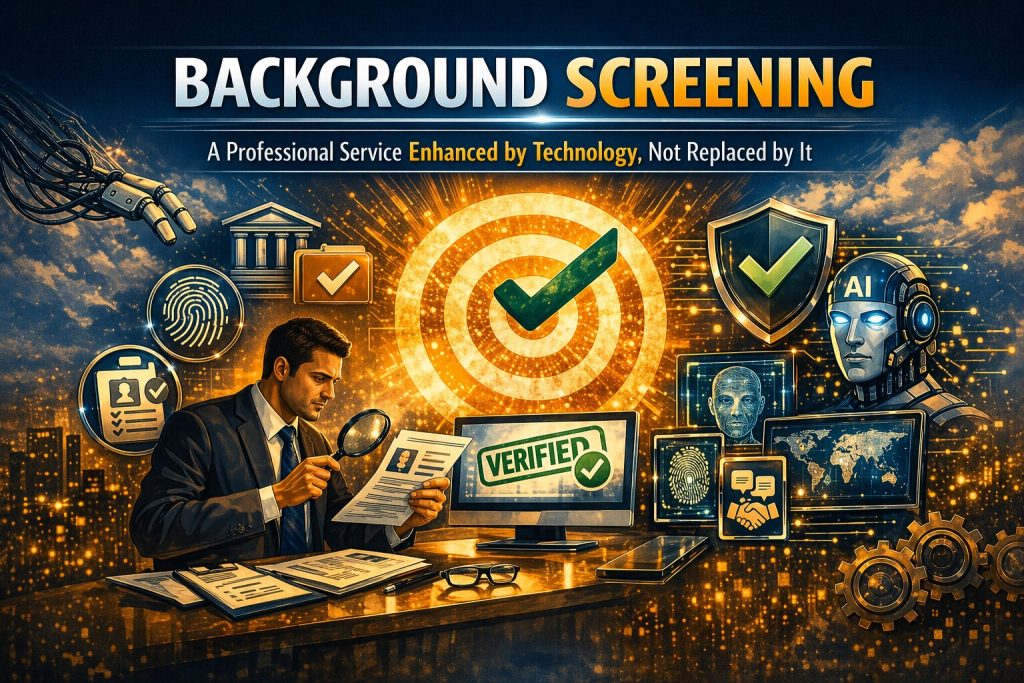
Background Screening: A Professional Service Enhanced by Technology, Not Replaced by It |
back to blog
By Attorney at Law Lester S. Rosen, Background Screening Consultant, Writer, and Presenter
I. Introduction
In today’s hiring environment, background screening remains mission-critical for employers. Since an organization is often only as good as its people, the need to hire qualified, honest people is paramount. Equally important is avoiding bad hires who can cause workplace disruption, or may not have the skill, experience, or credentials claimed.
To accomplish these due diligence checks, an employer typically turns to a professional background screening firm to perform these services. However, just as it is important to select the right employees, it is equally important to pick the right background screening firm.
There are several factors that go into selecting any vendor of Human Resource services. These can include, for example, a firm’s expertise, reputation, turnaround time, customer service, and ability to provide what is needed.
However, as advancements are made in the technology surrounding background checks, there is an emerging factor that HR professionals may need to consider. HR professionals are well advised to consider if a firm provides a professional background screening service, or whether the service is just a technology-driven data acquisition firm using technology to lure clients with speed and lower costs.
While technology has certainly improved the efficiency and speed of background checks, HR professionals may want to consider a screening firm that prioritizes client support, subject matter expertise, and compliance. If a firm is primarily a technology firm that specializes in data acquisition, HR teams may face delays, inaccuracies, compliance issues, frustrated applicants, and a lack of guidance when making critical hiring decisions.
The reason is that background screening is much more than just retrieving data. It is a professional service that requires a deep understanding of compliance issues in a complex legal landscape and expertise in the sources, quality, and limitations of data, and human expertise to ensure accuracy and customer service. Employers prioritizing technology over service may expose themselves to bad decisions, mistakes, and lawsuits. It could also cause employers to mistakenly use data that is incomplete or incorrect.
This article explores why employers should seek a background screening provider that delivers not only cutting-edge technology but also exceptional customer support, expertise, and legal compliance knowledge to create a hiring process that accomplishes the employer’s goal rather than create chaos or legal liability.
II. Why Background Screening is More Than Just Data Retrieval
If screening firms market themselves as technology-driven solutions, with automated platforms that deliver background check reports instantly, that should raise red flags for employers. While automation has streamlined certain aspects of screening, it cannot replace customer service and compliance expertise. Background checks are a great deal more than mere data retrieval—they require:
- A Deep Understanding of the Data: Not all data is created equally. It requires industry expertise to understand if the data is actionable, accurate, and complete. Actionable means what can be used under federal and state laws and regulations. Accurate means the information reported is correct and exact. Complete means the entire relevant record has been obtained and analyzed. For example, has there been a subsequent judicial system set aside such as an expungement so the record can no longer legally be used? This all requires substantial training and expertise and an understanding of the sources and limitations of data.
- Incomplete Records: It is well known in the screening industry that not all states or counties have complete computerization of records. Records can be incomplete for a variety of reasons, including lack of computerized access, name variations, or subsequent judicial history that may not be available.
- Complex Records: Criminal records, employment history, and educational credentials can contain complex and inconsistent information that requires human oversight to verify the accuracy and relevance of the information. Data that seems suspicious on its surface may have a perfectly reasonable explanation, while data that seems valid can be inconsistent or derogatory when viewed in conjunction with other information.
- Compliance Complications: Background checks are governed by laws and regulations of 50 states as well as the federal government. There are even large counties and cities such as Los Angeles, New York, and San Francisco with their own rules. These rules can change often and with little notice making compliance a moving target that automation cannot handle alone.
- Contextual Analysis: Using technology to flag a record can be efficient, provided it is reviewed by a trained person and not used to automatically disqualify a candidate. Screening professionals can assist employers in evaluating the nature and gravity of an issue, how it relates to the job, and any mitigating circumstances the employer should consider.
- Responsive Customer Support: For HR professionals, screening is a professional service. When an issue arises, such as why a record is late or what a record means, an HR professional normally wants to talk to a professional, not an algorithm. Firms that prioritize technology at the expense of professional customer services may leave an employer to navigate the screening process and hiring decisions without guidance.
- False Positives and False Negatives: Automated systems lack the ability to verify whether a record truly belongs to the candidate being screened, leading to cases of mistaken identity, or missing critical records. A False Positive means a criminal record is incorrectly attributed to a candidate. A False Negative means a candidate in fact has a criminal record that is potentially relevant, but the automation misses it.
- Inaccurate or Outdated Data: Background checks are pulled from multiple sources, many of which require manual verification. Automated systems may not account for variations in reporting or give incomplete records. There are over 3,200 counties in the United States with data, and a significant number have systems that are not complete or up to date. Relying on automated sources and instant results carries a probability of error that an employer cannot ignore.
- Failure to Adhere to Legal Requirements: Screening laws, including “Ban-the-Box” and Fair Chance Hiring regulations, vary widely across states and cities. Without human oversight, employers risk violating compliance laws. In addition, states have complex laws regarding reportability. Most states, for example, have judicial set-aside and reporting or usage rules. If an employer improperly utilizes a piece of data that is not allowed, it can have legal and economic consequences.
III. The Critical Role of Professional Judgment in Background Screening
A truly effective background screening process is one that balances efficiency with accuracy and human involvement. While technology helps to speed up searches, it is the expertise of screening professionals that ensures results are legally compliant and contextually appropriate. The best background screening firms integrate:
- Expert Record Analysis: Trained professionals review flagged reports to determine if the information is accurate and reportable.
- Competency in Determining the Value of Data Sources: Just because a report is “instant” does not mean it is accurate or complete. Instant data is only as good as the data source and a significant number of data sources cannot be relied upon to give employers the full story. A background screening firm that understands the industry is able to conduct due diligence on each source of data to determine if it is complete and accurate.
- Legal Guidance: Dedicated compliance teams help HR professionals navigate complex screening laws and avoid costly mistakes. A screening firm cannot give legal advice but can provide guidance or insights based on generally accepted industry understandings.
- Candidate Communication Assistance: A professional screening firm ensures fair hiring practices by allowing candidates to clarify discrepancies and dispute inaccurate records under the federal Fair Credit Reporting Act (FCRA).
- Promote Candidate Engagement: Screening firms that rely on technology alone may not provide candidates with assistance in using the system, or provide meaningful opportunities to dispute or clarify flagged records, creating potential liability for HR departments. It is critical for employers competing for talent to provide an outstanding applicant experience which extends to the background check process.
IV. The Importance of Human Support in an Era of Automation
In industries where hiring decisions have long-term consequences, HR professionals need more than just data, they need insights. A screening firm that prioritizes human expertise provides invaluable support. Although Artificial Intelligence (AI) programmers have made advances in creating AI “agents,” there are far too many complications and subtleties to essentially rely on up a robot to analyze complex situations. AI “agents” and bots have been used successfully to improve customer service, but when it comes to the complex situations involved in screening, a bad answer will not merely result in the loss of a client, but litigation as well.
As a result, HR professionals should be wary of firms that focus solely on automation without prioritizing customer service. Without trained customer service and compliance professionals, employers will not have a qualified person to assist them in making a complex decision if something negative, inconsistent, or derogatory if found.
Candidate experience is also key in the hiring process. Leaving background checks to be conducted by an AI agent may also lead to poor candidate experiences. For example, a candidate may have an issue using the online software to fill out the necessary forms for the background check. Or the candidate may not be able to navigate the adverse action process or advise a screening firm as to why information is incomplete or incorrect as required under the FCRA.
V. The Advantages of Prioritizing a Professional Service
Employers that partner with a professional background screening firm—rather than a technology-driven service—benefit from:
- Higher Accuracy Rates: Human oversight combined with technology ensures that records are properly matched, reducing errors and ensuring fair hiring practices.
- Better Legal Protection: Compliance experts help employers navigate complex regulatory environments, minimizing legal exposure.
- Enhanced Employer Experience: With a firm that prioritizes customer service, an employer has a partner that understands their needs and can answer questions, as opposed to a “chatbot.”
- Enhanced Hiring Confidence: HR teams can make more informed hiring decisions with the support of experienced screening professionals.
- Improved Candidate Experience: When candidates have a fair opportunity to clarify and correct records, employers enhance their reputation and attract top talent.
VI. Conclusion: The Competitive Advantage of Choosing a Professional Screening Firm AND Avoid Purely Technology-Driven Screening Solutions
In the background process, employers need accuracy, completeness, compliance assistance, and knowledgeable human beings to work with if delays occur or issues arise.
Technology has undeniably improved the background screening industry, making processes faster and more efficient. However, firms that rely exclusively on automation place HR professionals at risk of receiving inaccurate reports, violating compliance laws, and making poor hiring decisions. A comprehensive background screening approach—one that combines cutting-edge technology with human expertise—is the key to ensuring accuracy, legal compliance, and risk mitigation.
HR professionals should prioritize a background screening firm that integrates professional judgment with technology to provide accurate, legally sound, and contextually relevant hiring insights. The investment in a professional service model not only improves hiring outcomes but also protects organizations from costly legal and reputational risks.
For HR teams that prioritize thoroughness and compliance, the choice is clear: Technology should enhance background screening, not replace the professionals who ensure its accuracy and reliability.
About the Author
Lester S. Rosen is an attorney at law and Founder of Employment Screening Resources (ESR), a service offering of ClearStar as of December 2021. He is a consultant, writer, expert witness, and frequent presenter nationwide on pre-employment screening. He is the author of “The Safe Hiring Manual” (3rd Edition 2017/826 pages), the first comprehensive book on background screening. He served as the chairperson of the steering committee that founded the Professional Background Screening Association (PBSA), served as its first co-chair, and received the PBSA Lifetime Achievement Award in 2019.
Please Note
Nothing in this article is given or intended to be used as legal advice but is provided for general educational purposes only. The opinions expressed in this article are the opinions of the author and do not necessarily reflect the organization publishing the article.
About ClearStar
A founding and accredited member of the Professional Background Screening Association (PBSA), ClearStar has provided innovative background screening solutions to the Human Capital Management (HCM) industry from its corporate offices in Alpharetta, Georgia, since 1995 and is celebrating its 30th Anniversary in 2025. To learn more, contact ClearStar.
Original article: https://www.clearstar.net/background-screening-a-professional-service-enhanced-by-technology-not-replaced-by-it/